

AT A GLANCE
Study in Ireland — At a Glance
A quick overview before you explore the details below.
Study Levels
Bachelor's, master's and doctoral programmes are offered across Irish universities and colleges.
Popular Study Areas
Technology, business, life sciences and pharmaceuticals are widely studied, alongside many other fields.
Typical Intakes
Many institutions offer a September intake, with some also offering a January start.
English Language Planning
Tests such as IELTS, PTE and TOEFL are commonly accepted, subject to each institution.
Application Planning
Applications may be made directly or through a central application service depending on the course.
Visa Route
Eligible students generally apply for an Irish student visa or preclearance after receiving an offer.
Why Consider Ireland?
Ireland’s universities and colleges offer a range of undergraduate and postgraduate courses taught in English, making it a popular option for students who want to study in a well-established international academic environment without navigating a language barrier.
With a long-standing tradition of welcoming international students, Ireland offers a supportive academic community alongside the opportunity to experience a new culture and way of life while studying.

EDUCATION SYSTEM
Understanding the Irish Education System
Irish higher education includes universities, institutes of technology and other higher education colleges. Bachelor's degrees typically take three to four years, followed by one- or two-year master's programmes and doctoral study. Institutions vary in focus and course structure, so comparing individual programmes is important.
POPULAR COURSES
Popular Courses to Study in Ireland
Popular study areas include the following. Availability and specialisation vary by institution.
Computer Science & IT
Software, systems and computing-focused programmes.
Life Sciences & Pharmaceuticals
Life sciences, biotechnology and pharmaceutical-related programmes.
Business & Management
General and specialised management and MBA-style study.
Data Science & AI
Analytics, machine learning and applied data programmes.
Finance & Accounting
Finance, accounting and related quantitative programmes.
Engineering
A broad range of engineering disciplines and specialisations.
Law
Law programmes, which vary significantly in structure between institutions.
Media & Communication
Media, journalism and communication-focused programmes.
Explore Your Study Options
Students can explore undergraduate, postgraduate, and research-based study pathways in Ireland. Broad academic areas students may explore include:
Business
Engineering
Computer Science & Technology
Health-Related Fields
Data & Analytics
Arts & Social Sciences
These are examples of broad academic areas students may explore, not a list of courses offered directly by Maram Overseas.
ENGLISH LANGUAGE
English Language Requirements
Many Irish institutions accept IELTS, PTE, TOEFL or equivalent tests, though accepted tests and required scores vary by institution and course. Some applicants may be exempt depending on their prior education. Always confirm current requirements with your chosen institution.
Choosing a University & Applying
Once you have an idea of what you would like to study, the process of choosing a university and preparing your Irish application generally follows a similar pattern:
Identify suitable courses based on your goals
Compare institutions and course structures
Review entry requirements
Prepare required documents
Complete application materials
Submit applications and respond to admission communication
APPLICATION PROCESS
How to Apply to Universities in Ireland
A general sequence students can follow when applying — steps and requirements vary by institution.
01
Define Your Study Goal
Clarify your academic interests, career direction and preferred study level.
02
Select Course & Study Area
Compare study areas and course structures across institutions.
03
Shortlist Institutions
Narrow your options based on course fit, location and personal priorities.
04
Review Entry Requirements
Check each institution's academic and English-language requirements.
05
Prepare Documents
Gather academic records, test results, your personal statement and other required materials.
06
Submit Application
Applications may be made directly or through a central application service.
07
Receive & Review Offer
Review your offer conditions before accepting and preparing for your visa.
Student Visa Guidance
Once you have progressed with your Irish study plans, the next stage is preparing for the relevant student visa process, where applicable. This may involve gathering required documentation, completing the appropriate application steps, and preparing for any applicable verification or interview requirements.
Maram Overseas can provide guidance on preparing your documentation and understanding the application process.
Visa decisions are made by the relevant authorities, and no visa outcome can be guaranteed.
STUDENT VISA
Understanding the Student Visa Process
A general outline of the process. No visa outcome can be guaranteed.
01
Admission Offer
An offer from a recognised Irish institution is generally required first.
02
Financial Documentation
Applicants generally show evidence of funds to cover tuition and living costs.
03
Visa Application
The student visa or preclearance application is submitted through the relevant Irish process.
04
Biometrics & Registration
Applicants may need to attend an appointment and register with immigration authorities on arrival.
05
Decision
Visa decisions are made by Irish immigration authorities.
06
Pre-Departure Preparation
Once approved, students can begin practical preparation for travel and arrival.
Before You Go
Documentation Readiness
Travel Preparation
Accommodation Planning
Personal Preparation
DOCUMENTS
Documents You May Need
Requirements vary by institution and visa category — the following may be required.
Academic Documents
Transcripts and certificates confirming your prior education.
Passport
A valid passport is required for the application and visa process.
English Test Results
Score reports for tests such as IELTS, PTE or TOEFL, where required.
Personal Statement & References
A personal statement and, where applicable, academic references.
Financial Documents
Evidence of funds to support tuition and living costs, where required.
Offer & Visa Documents
Your admission offer and supporting documents for the visa application.
BUDGET & FUNDING
Planning Your Budget & Scholarships
Costs and funding options vary — always confirm current figures with your institution.
Tuition
Varies significantly by institution, course and study level.
Accommodation & Living Costs
On-campus, private rentals and homestay options carry different costs.
Health Insurance
International students are generally required to hold health insurance.
Institution Scholarships
Some institutions offer merit- or need-based scholarships to eligible students.
External Funding
Government-linked or third-party scholarships may be available depending on your background.
Research Funding
Postgraduate students may explore research funding opportunities, where available.
CAREER & STUDENT LIFE
Career & Student Life in Ireland
Options and rules can change — always check current official guidance.
Career Planning
Choosing a course aligned with your career direction can support your longer-term goals.
Internships & Work Experience
Many programmes include placement or practical components — check what each course offers.
Post-Study Options
Graduates may explore post-study work options, subject to current immigration rules.
Campus & Community Life
Institutions typically offer societies, housing options and international student support.
Part-Time Work
Students may be permitted to work part-time under certain conditions — confirm current visa rules.
Adjusting to a New Culture
Settling into a new environment takes time; institutions often offer orientation support.
Why Work With Maram Overseas for Your Ireland Journey?
01
Destination-Focused Planning
Support focused on understanding Ireland's study environment alongside your goals.
02
Academic Pathway Guidance
Practical help comparing Irish courses and institutions to find the right fit.
03
Application Preparation
Guidance as you organize and prepare your Ireland study application.
Top Universities in Ireland
Explore universities across Ireland and discover options that align with your preferred course, career goals, location and study plans.
Trinity College Dublin
University College Dublin (UCD)
University College Cork (UCC)
University of Galway
Dublin City University (DCU)
University of Limerick
Maynooth University
Technological University Dublin (TU Dublin)
Munster Technological University
Technological University of the Shannon (TUS)
Atlantic Technological University (ATU)
South East Technological University (SETU)
RCSI University of Medicine and Health Sciences
Dublin Business School
Griffith College
National College of Ireland
Dundalk Institute of Technology
Mary Immaculate College
National College of Art and Design
INTAKES
Ireland Intakes & Application Planning
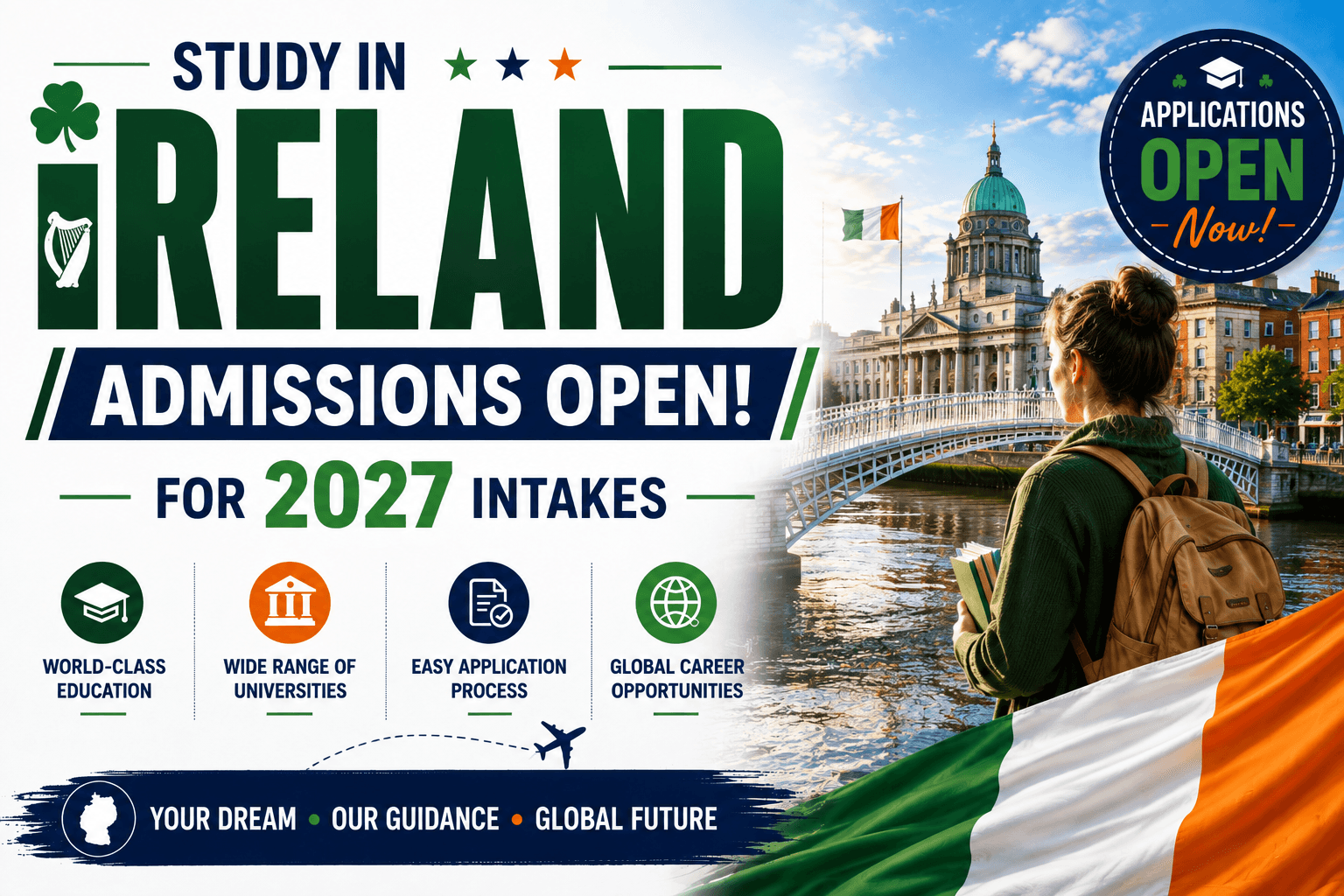
Common intake periods in Ireland may include a September start, with some institutions also offering a January intake. Availability varies by institution and course, and deadlines can fall many months in advance — always verify the intake and deadline for your specific programme.
FAQ
Ireland Study Abroad FAQs
Common questions students ask about studying in Ireland.